Electric Oven Calibration: Temperature Problems and Repairs
Electric oven calibration can help when the temperature shown on the control does not match the oven’s actual cooking temperature. However, calibration only corrects a repeatable temperature offset—it cannot repair a faulty element, sensor, thermostat, fan, control board or electrical connection.
Table of Contents
ToggleThis guide explains the safe checks a homeowner can make, the warning signs that point to a component fault, and when to arrange electric oven repairs in Melbourne. Electrica Co provides mobile service to customers across Melbourne CBD, the inner city, northern suburbs and western suburbs.
Key Takeaways
- Calibration corrects a consistent temperature difference; it does not repair failed electrical parts.
- Check the appliance manual before changing any user-accessible temperature setting.
- Oven temperatures naturally rise and fall as the heating system cycles.
- Do not remove panels, touch wiring or test live electrical components.
- Repeatedly inaccurate, uneven or unsafe heating needs professional diagnosis.
What Does Electric Oven Calibration Mean?
Electric oven calibration is a model-specific adjustment to the relationship between the selected temperature and the temperature maintained inside the cavity. Some digital ovens provide a user-accessible temperature offset in the settings menu. Some mechanical controls require service procedures, while other models do not offer a separate calibration adjustment.
Always follow the manufacturer’s manual for the exact model. A setting used on one brand or control system may be unsuitable for another. Calibration should never be used to hide symptoms of a damaged component.
Signs Your Oven Temperature May Be Inaccurate
- Food repeatedly cooks faster or slower than expected using familiar recipes.
- Baked food is consistently underdone or overdone despite the same settings and rack position.
- An oven-safe thermometer shows a repeatable difference from the selected temperature.
- The oven takes noticeably longer to preheat than it previously did.
- Results vary significantly between cooking functions such as fan bake and conventional bake.
Food that is burnt on one side and undercooked on the other may be an airflow, element or fan problem rather than calibration. See our guide to an electric oven cooking food unevenly.
Safe Checks Before Adjusting the Calibration
Confirm the Cooking Function and Rack Position
Fan bake, conventional bake and grill use different components and airflow patterns. Confirm that the selected function and rack position match the recipe and the appliance manual before deciding the temperature is inaccurate.
Use an Oven-Safe Thermometer
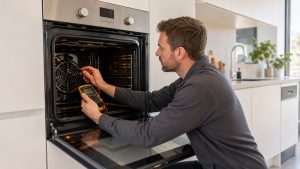
Place an oven-safe thermometer in the position recommended by its instructions and the oven manual. Allow the oven to preheat fully and observe more than one heating cycle. A single reading can be misleading because the temperature normally moves above and below the set point while the elements switch on and off.
Check the Model-Specific Manual
If the oven has a user-accessible temperature offset, follow only the steps and permitted adjustment range stated in the manufacturer’s manual. Do not copy a button sequence from a different model.
Keep Electrical Parts Closed
Do not remove the oven from its cabinet, open covers, disconnect wiring or test internal components. Energy Safe Victoria advises consumers not to repair faulty electrical appliances themselves and to use an appropriately qualified repairer or licensed electrician. Read the official Energy Safe Victoria appliance-safety guidance.
Calibration or Electrical Fault?
| Symptom | More likely next step |
|---|---|
| Temperature is consistently a little high or low on every cycle | Check the manual’s user calibration procedure |
| Temperature varies widely or changes between uses | Arrange testing of the sensor, thermostat or control system |
| Only one cooking function heats incorrectly | Check for an element, fan, switch or control fault |
| Oven does not heat or takes much longer to preheat | Book an electrical diagnosis rather than repeated calibration |
| Burning smell, sparking, buzzing or circuit tripping | Stop using the oven and arrange urgent professional inspection |
When Calibration Will Not Fix the Problem
Calibration cannot compensate for a component that is failing. Common causes of inaccurate or unstable electric oven temperatures include:
- Temperature sensor or thermostat fault: the control receives an inaccurate temperature signal or switches at the wrong point.
- Heating element fault: one element may heat weakly, intermittently or not at all.
- Fan or airflow problem: heat is not distributed evenly through the cavity.
- Control-board or selector fault: the selected function or heating cycle is not controlled correctly.
- Loose or overheated connection: damaged terminals or wiring can interrupt heating and create a safety risk.
Our oven element, thermostat and sensor guide explains how these faults can produce similar symptoms. If the appliance is not heating at all, see why an electric oven stops heating.
How a Licensed Electrician Diagnoses an Inaccurate Oven
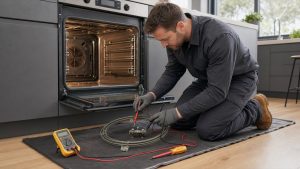
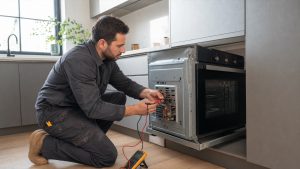
A professional diagnosis separates a simple control offset from an electrical fault. Depending on the symptoms and model, the electrician may compare temperature performance across heating cycles, inspect elements and connections, and test the sensor, thermostat, controls, insulation and electrical supply.
This prevents unnecessary calibration changes and identifies faults that could worsen if the oven continues operating. Electrica Co works on domestic electric ovens and provides mobile service to customers rather than operating a customer-visit workshop.
Electric Oven Calibration and Repairs Across Melbourne
Electrica Co services electric ovens across Melbourne CBD and the inner city, the northern suburbs and the western suburbs, including Coburg, Northcote and surrounding areas.
If testing confirms that a new part is required, new parts supplied and installed by Electrica Co. are covered by a 12-month warranty.
Arrange an Electric Oven Temperature Inspection
If your oven remains inaccurate after the manufacturer-approved checks, or the temperature varies unpredictably, arrange a licensed inspection before making further adjustments. Contact Electrica Co or request an electric oven repair in Melbourne.
FAQs:
Calibration is recommended if you notice inconsistent cooking results or after significant usage over time.
It’s best to use an oven-safe thermometer designed for high temperatures to ensure accurate readings.
Some models may not have user-accessible calibration settings. In such cases, professional servicing is advised.
Performing calibration as per the user manual typically doesn’t affect the warranty, but it’s advisable to check the warranty terms.
After calibration, test the oven with the thermometer to confirm the temperature aligns with the set value.